Overtone
Kportscan 30 - Upd _top_
In conclusion, KPortScan 3.0 UPD is a powerful and versatile port scanner that provides valuable insights into network services and open ports. Its ease of use, comprehensive feature set, and open-source nature make it a popular choice among network administrators and security professionals. Whether used for network inventory, vulnerability assessment, or troubleshooting, KPortScan 3.0 UPD is an essential tool in the realm of network security and administration.
In the realm of network security and administration, port scanning is a crucial technique used to discover open ports and services on a network. One popular tool used for this purpose is KPortScan 3.0 UPD, a free and open-source port scanner. In this essay, we will explore the features, functionality, and significance of KPortScan 3.0 UPD. kportscan 30 upd
KPortScan 3.0 UPD is a network port scanner designed for Windows operating systems. The "K" in KPortScan likely stands for "Kathy" or a similar nomenclature, although the creator's name is not widely documented. UPD, on the other hand, stands for "Universal Packet Dispatcher" or possibly " Updated". The tool was first released in the early 2000s and has been updated to version 3.0. In conclusion, KPortScan 3
Examples
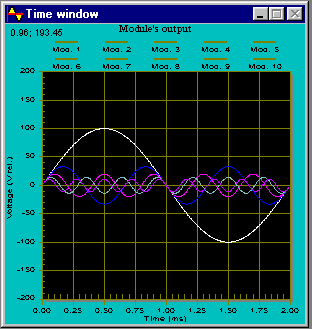
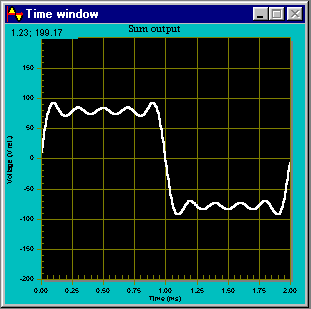
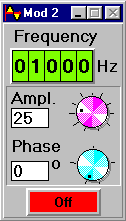
You can test the Helmholtz assumption that the relative phases of the overtones are irrelevant to hearing.
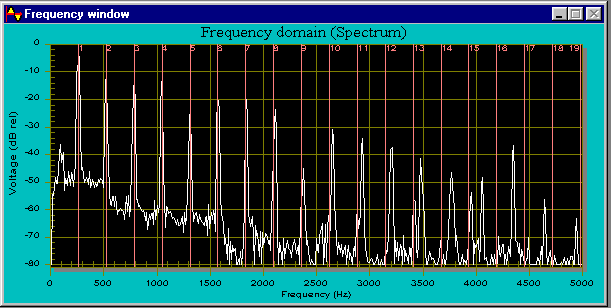
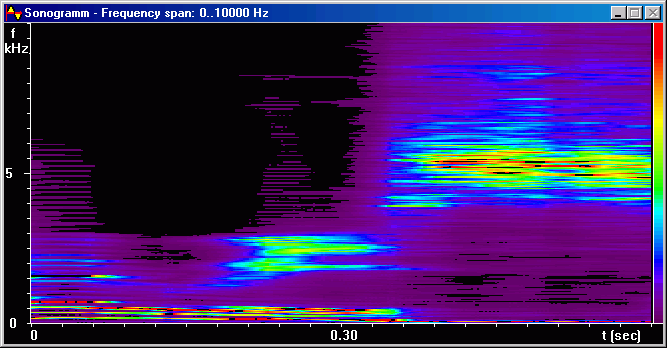
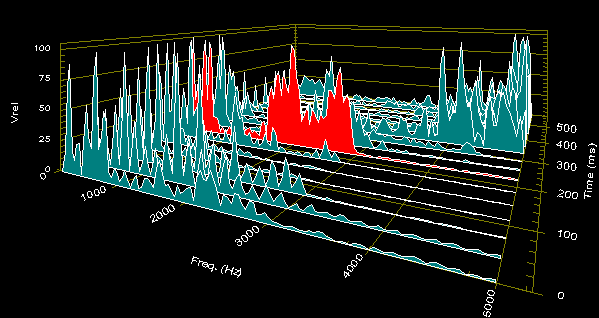
In analyser experiments you capture sound from the sound card or from a WAV file up to several seconds long, select the starting time of the time slice and analyse time and frequency responses. The example shows the spectrum of a piano playing a middle C (262 Hz). The non-harmonic overtones are clearly seen. (Due to the stiffness of the string, the frequencies of the partials are too high.)
Download version 1.15, June 2009: OVERTONE.ZIP
(1.55 MB)
Unpack in a new folder, read README.TXT and start OVERTONE.EXE
(Some firewalls or User Access Control (UAC) may block execution. Give OVERTONE the necessary permissions.
Make sure, that the sound device is not used by another application.)
For more information, send e-mail to address given in README.TXT
Unterrichtseinheit Analyse von Klangspektren von Alain Hauser (in German)
